


love this post? share it!
The Challenge
Some executives don’t need to build credibility from scratch. They need a platform that matches the credibility they already have.
This engagement centered on a university professor with a rare profile: a globally recognized researcher, a former director of a major federal science agency, and an active voice in international AI and innovation policy. He was regularly on stages in New Delhi, Tokyo, and Washington. He was shaping conversations that most executives only observe.
The opportunity wasn’t visibility in the traditional sense. It was ensuring that the people who needed to know this leader – policymakers, researchers, journalists, international partners, and institutional peers – were actually seeing his work, his thinking, and his point of view.
That required something most executive visibility programs don’t account for: a deep understanding of university positioning. His personal brand needed to stand on its own. But it also needed to serve as an amplifier for the university’s innovative mission at the right moments. Those two things can pull in opposite directions. The work was knowing how to navigate both.
The Approach
We started, as we always do, with strategy. A 90-minute discovery session helped us map the executive’s priorities, audiences, and the specific doors this platform was meant to open. From that, we built a content approach around three pillars: AI and the long-term case for federal investment in research, international partnership and global science governance, and human stories that grounded big ideas in real moments.
There was another layer to that strategy work. After years leading a major federal agency, this leader had adopted the publicly neutral tone the role requires. Careful. Measured. Deliberately balanced. That posture served him well in government. But this was a new chapter.
His insights were no longer in service of an administration’s agenda. They were his own. Part of our work was helping him build comfort with that – sharing perspectives that challenged the status quo, leading with his own point of view, and showing up with the kind of conviction that genuine thought leadership requires. The messaging we developed aligned with his beliefs, his expertise, and the university’s ambitions. All at once.
Every month, we ran two tracks in parallel.
Organic Content
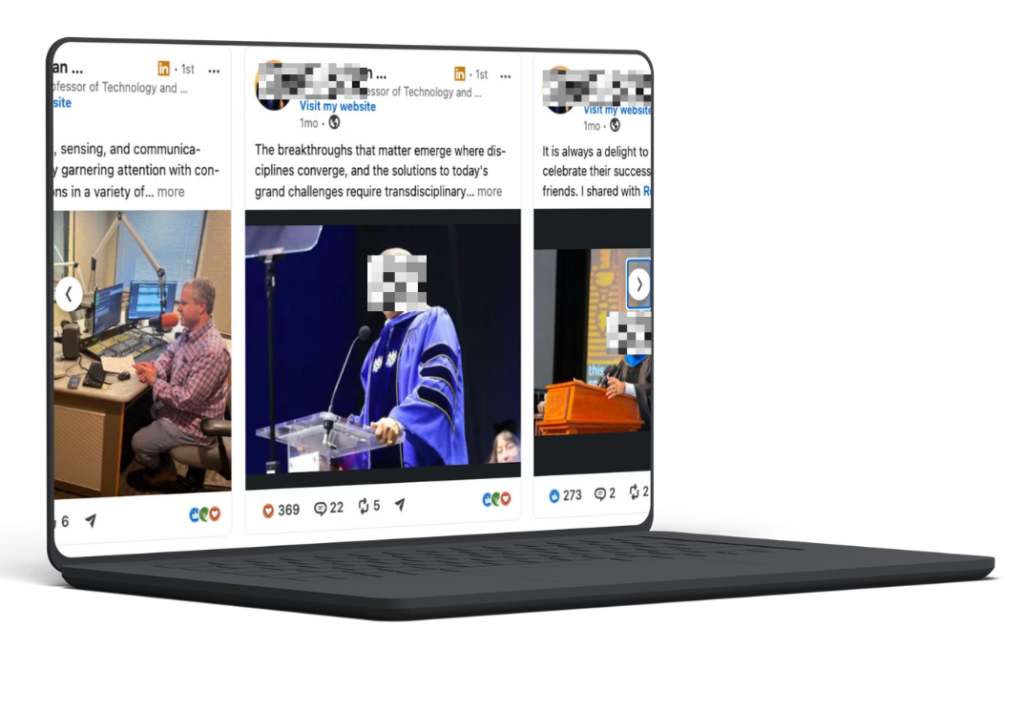
We developed LinkedIn content that moved between policy and personal – not because those are different things for this leader, but because they’re the same thing told at different scales. A post about US-India collaboration in AI policy and a post about a stranger who offered a water bottle at the gym both performed at the highest level. Both were true to who he is. That consistency is what builds a platform that lasts.
We also posted from speaking engagements and international events in real time – the India AI Impact Summit in New Delhi, a forum in Tokyo, the National Postdoctoral Association conference – giving his network a window into his work as it happened, not after the fact.
Paid Thought Leader Ads
Alongside organic content, we ran LinkedIn Thought Leader Ads amplifying his highest-performing posts to a targeted senior-level audience. The targeting strategy evolved each month – refining away off-target segments, expanding into public sector audiences, and doubling down on video formats as they proved to outperform static assets.
Video on AI consistently led the account. That signal shaped the creative roadmap for the months ahead.
The Results
Over three months, the program built a pattern of performance that compounded month over month.
- 180,000+ organic impressions in the first month of the program
- Nearly 400 visitors driven to the university’s research content hub through the LinkedIn Premium button from one post- a direct line from content to institution
- Top-performing assets: 1.91%, 2.05%, and 2.21% CTR – up to 4x the industry benchmark
- Average dwell time of 9-12 seconds per ad, nearly 2-3x the 3-5 second industry standard for single-image ads. These aren’t just impressions; these are people stopping to read deeply
- 4.56X Frequency in a single month, enough repetition to build genuine top-of-mind recall among senior targets
Audience Quality
The numbers matter. But the audience behind the numbers is what makes this program remarkable.
Across the program, the profile drew consistent, documented attention from an extraordinary range of individuals and institutions. Bloomberg News editors. BBC journalists. Reporters from The New York Times. A research associate in the office of Eric Schmidt. Officials from the US Department of Energy and the National Science Foundation. The Japan Science and Technology Agency’s Washington DC office. MIT’s Washington office. Princeton University. Howard University. Harvard Law School.
On the industry side: Intel, Microsoft, Salesforce, Amazon, Google, and Boston Consulting Group.
Internationally: government and academic leaders from India, Japan, Australia, New Zealand, and Mexico. Science governance officials across multiple countries.
When the same cluster of journalists, policymakers, and institutional leaders showed up repeatedly across different posts on different topics, the signal was clear. This executive wasn’t just reaching an audience. He was becoming a recurring figure of interest to exactly the people whose attention matters most for his work.
That’s what a well-built platform produces. Not just impressions. Recognition.


